

Laser MArking
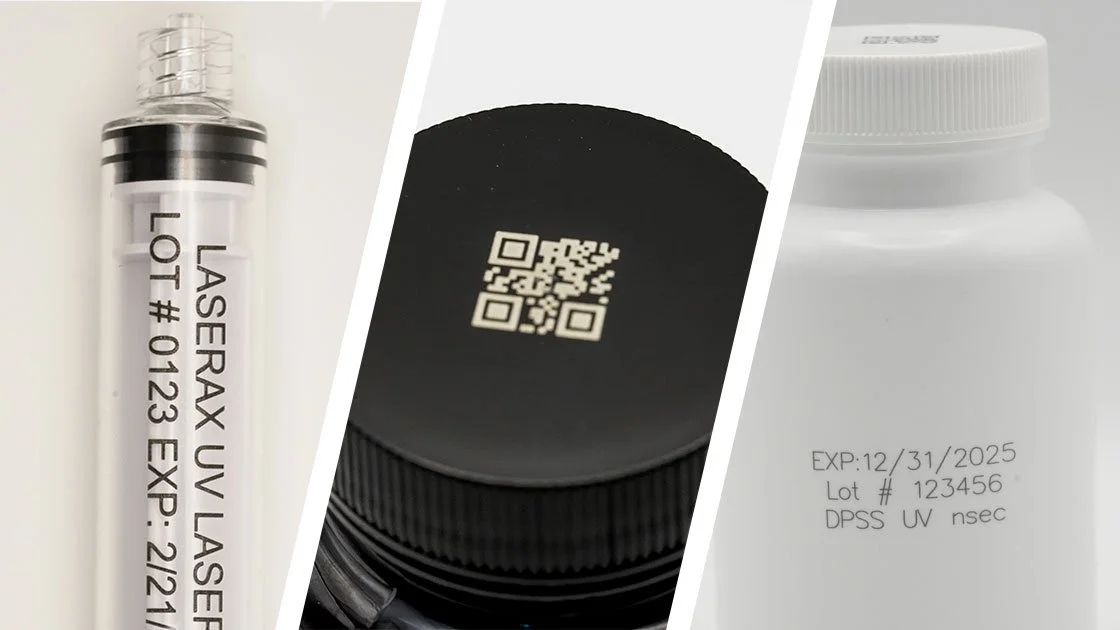
When it comes to precision and versatility, UV lasers are the best choice to mark plastics. They’re the only lasers with the ability to mark extremely small codes, with standard spot sizes down to 7 um micron. These spot sizes simply cannot be achieved with fiber or CO2 lasers for marking.
One of the main advantages of UV lasers is their ability to interact with several materials through photochemical mechanisms. UV lasers are frequently called “cold lasers,” as the desire is to use them to mark products and not heat up the surface surrounding or underneath the marked area.
UV lasers can induce color changes on substrates to create high-contrast marks. While fiber lasers can also achieve this effect, they produce heat on the surfaces, and are limited to certain substrates.
Laserax’s DPSS UV lasers offer the largest marking field in the industry at 1 meter, compared to 300 mm for competitors. They also feature a variable focal distance and deliver average power levels of up to 55 W, ensuring effective and high-contrast marking on plastics.
-
A high-contrast color change occurs when laser marking light-colored plastics. The process can produce various shades of gray depending on the UV laser settings and material.
-
Photo bleaching the colorant within the plastic with a UV laser produces various shades of white on a dark substrate.
-
Transparent plastics are blends of different chemicals, and the UV laser reacts differently with each component. The desired result is usually black or gray marks of varying contrasts.
-
Commonly markable plastics:
Polybutylene terephthalate (PBT)
Polycarbonate (PC), transparent and colored
Polyethylene (PE), including HDPE and LDPE, as well as PETE
Polyester (PES)
Polyamide (PA)
Acrylonitrile butadiene styrene (ABS)
Polyethylene terephthalate (PET), transparent and colored
Polyimide (PI)
Polyoxymethylene (POM), e.g., Delrin®
Polypropylene (PP)
Polyphenylene sulfide (PPS)
Polystyrene (PS), transparent
Polystyrene (PS), colored, including HIPS (High Impact PS)
Polyurethane (PUR)
Foam (PVC free)
PVC, transparent and colored
Acrylics (PMMA), clear and colored/tinted
PEEK
Polytetrafluoroethylene (PTFE), especially colored
BioPlastics, such as colored PFA
Non-plastic materials that act like plastics:
Silicones
Rubber